
Do You Need to Stop GLP-1 Medications Before Surgery or Anesthesia? What Current Guidance Really Says
Confused about stopping GLP-1 meds before surgery or colonoscopy? Learn why aspiration risk matters, who is higher risk, what current guidance says, and a pre-procedure checklist.

GLP-1 Medications Before Surgery: When and How to Pause
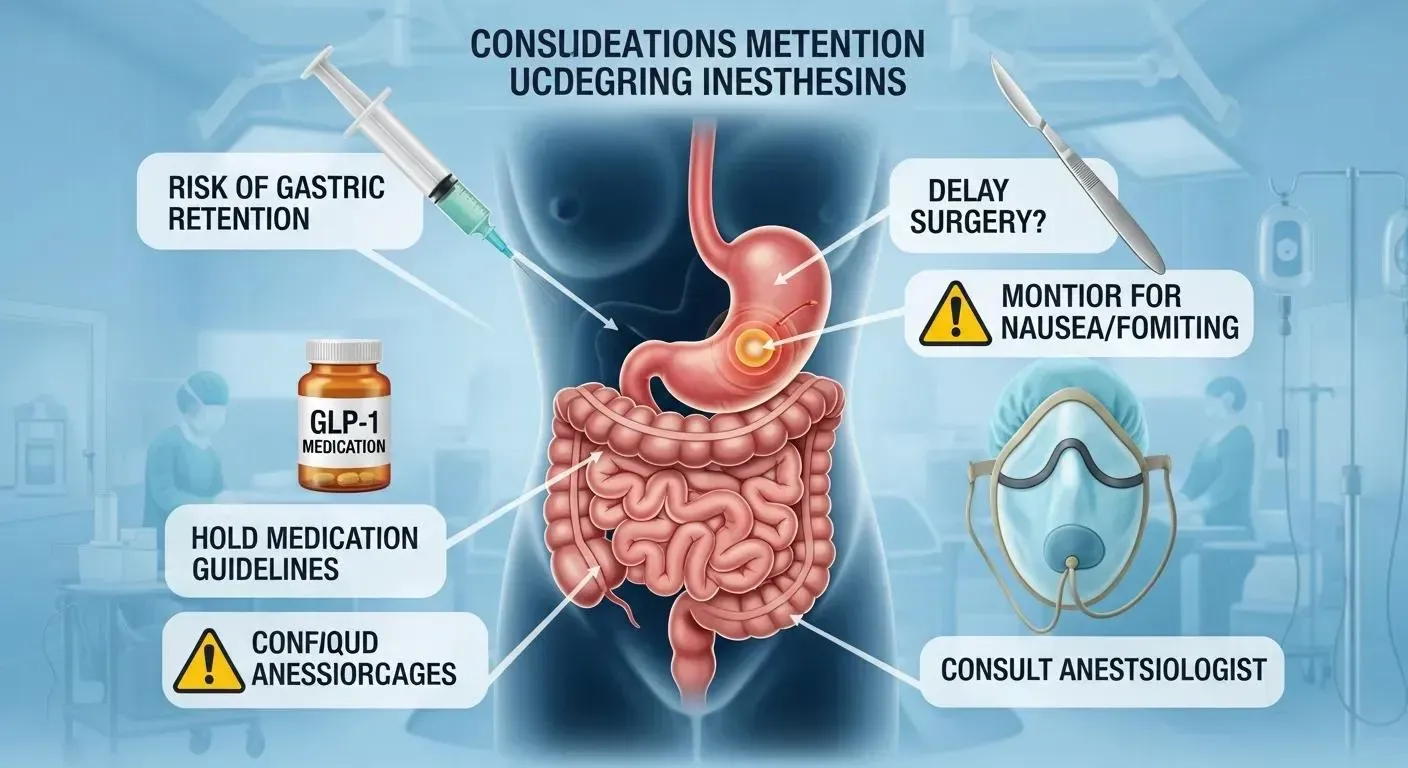
If you’re taking a GLP-1 medication (like semaglutide or tirzepatide) and have an upcoming surgery, colonoscopy, or procedure with anesthesia or deep sedation, you’ve probably heard conflicting advice about “holding” the medication. The safest approach is to treat this as a team decision based on your personal risk of delayed stomach emptying and aspiration.
This guide explains why the concern exists, what recent multi-society guidance emphasizes, and what to do to avoid last-minute cancellations without giving you dosing instructions.
For a clinician-guided overview of weight-loss options and support, start here. See“ StemVera - Weight Loss.”
Why are GLP-1s a concern before anesthesia or deep sedation?
GLP-1 medications can slow how quickly food leaves your stomach (delayed gastric emptying). That matters because anesthesia and deep sedation reduce protective airway reflexes, and stomach contents can sometimes move backward and enter the airway (aspiration).
In other words: the issue isn’t “GLP-1s and surgery are unsafe.” The issue iswhether your stomach might still contain food or thick liquids even after standard fasting, and whether your anesthesia plan needs to account for that. See,“ Drugs for Diabetes or Weight Loss: What To Know Before Surgery.”
Do most patients need to stop a GLP-1 before elective surgery?
Often,no many patients can continue GLP-1 therapy, especially if they’re stable on the medication and don’t have active GI symptoms. Recent multi-society guidance focuses on risk-stratifying patients and using mitigation steps (like a liquid diet) rather than automatically stopping everyone. See, “ Most Patients Can Continue GLP-1 Anti-Obesity Drugs Before Surgery .”
That said, some teams may still ask patients to hold a GLP-1 particularly if the patient is higher risk for delayed gastric emptying or if the procedure involves deeper levels of sedation. If your pre-op instructions differ from what you’ve read online, follow your surgical/anesthesia team’s plan and ask for the reason behind it.
Who is considered higher risk for delayed stomach emptying?
You may be higher risk if you are early in treatment or experiencing symptoms that suggest your stomach is emptying slowly.
Common higher-risk situations cited in clinical guidance include:
- You’re in the dose-escalation phase(recently started or still increasing)
- You’re on a higher dose
- You have active GI symptoms(nausea, vomiting, abdominal pain, significant constipation)
- You have another condition that can slow gastric emptying (for example, known gastroparesis)
Multi-society guidance lists similar risk factors and emphasizes planning early enough to adjust diet and peri-procedure precautions when needed. See“ Multi-society Clinical Practice Guidance for the Safe Use of GLP-1 Receptor Agonists in the Perioperative Period.”
What should you tell your surgical or endoscopy team (and when)?
Tell them as soon as the procedure is scheduled, not the day before. Most last-minute cancellations happen when the team learns about GLP-1 use too late to use a safer plan.
Pre-procedure communication checklist
- The exact medication name (semaglutide vs tirzepatide) and whether it’s weekly or daily
- Whether you’re new to the medication or currently increasing doses
- Any current GI symptoms (nausea, vomiting, constipation, abdominal pain, bloating)
- Any history of delayed gastric emptying or gastroparesis
- Whether your procedure is planned under general anesthesia,deep sedation, or lighter sedation
- Your prescriber’s contact information (so the teams can coordinate if needed)
If you want to understand what a clinician review and follow-up cadence can look like in an online program, see“ StemVera
- How It Works.”

What plan options might your care team use to reduce aspiration risk?
Depending on your risk profile and procedure type, the team may choose a plan that minimizes aspiration risk without unnecessarily removing the benefits of your medication.
Plan option your team may consider Who it’s often used for What it’s trying to prevent What you should do Continue GLP-1 as prescribed Lower-risk patients (stable use, no GI symptoms) Avoid unnecessary metabolic disruption while maintaining safety Follow the fasting rules you’re given and disclose GLP-1 use early Liquid-only diet for 24 hours before the procedure Higher-risk patients (especially with symptoms or during escalation) Reduce the chance of solid food remaining in the stomach Follow the diet instructions exactly; ask what 'liquid-only' means for your center Day-of assessment (e.g., stomach ultrasound) or anesthesia full-stomach precautions When risk is uncertain, or GLP-1 wasn’t disclosed early Identify retained contents and adjust the anesthesia approach Arrive early and expect extra assessment if your team recommends it Delay or reschedule the procedure When symptoms are significant, or retained contents are likely Prevent aspiration in an unsafe window Don’t try to tough it out rescheduling is sometimes the safest choice A large cross-sectional study using pre-procedure gastric ultrasound found GLP-1 use was linked to increased residual gastric content, and longer interruption did not clearly reduce it supporting risk-based mitigation rather than uniform holds. See“ Residual Gastric Content in Patients Using GLP-1 Receptor Agonists.”
What are common mistakes and red flags on the day of the procedure?
The biggest mistake is assuming your team “doesn’t need to know” because you followed standard fasting. If the team finds out late, they may have fewer safe options.
Common mistakes
- Not disclosing GLP-1 use until check-in
- Describing symptoms vaguely (“my stomach feels off”) instead of naming nausea/vomiting/constipation and timing
- Trying to self-adjust timing or dosing without clinician direction
- Eating solids when told to follow a liquid-only plan
Red flags that should prompt medical guidance
- Vomiting, severe nausea, or significant abdominal pain in the 24-48 hours before the procedure
- Feeling unable to keep clear liquids down
- New shortness of breath or chest symptoms
If any red flags show up, contact your surgical/anesthesia team right away these symptoms can change the safest plan.
Two realistic mini-scenarios
Scenario 1: Stable user, low-risk procedure.
Neha has been on a weekly GLP-1 for several months, isn’t escalating, and has no nausea or constipation. She tells the endoscopy center during scheduling that she’s on a GLP-1. Her team keeps her on her medication, gives standard fasting instructions, and confirms there are no symptoms on the day of the procedure.
Scenario 2: New start with ongoing nausea.
Vikram started a GLP-1 two weeks ago and still has nausea and occasional vomiting. He has an elective surgery booked. When he discloses the medication and symptoms early, the team advises a safer plan either a 24-hour liquid-only diet with additional precautions or rescheduling until the escalation phase and symptoms settle.
FAQ: GLP-1s, colonoscopy, and elective procedures
Sometimes. Many colonoscopies use sedation rather than full general anesthesia, but aspiration risk still matters if delayed gastric emptying is suspected. Your endoscopy and anesthesia teams will determine the safest plan for your center and your sedation type.
Guidance has evolved, and practices still vary. The safest move is to ask your surgical/anesthesia team: “Am I high-risk for delayed gastric emptying, and what mitigation plan are we using?” Then follow their written pre-op instructions.
Restart timing depends on your procedure, nausea risk, and when you can reliably tolerate oral intake. Follow the specific instructions from your procedural team and prescribing clinician.
If you want clinician-guided weight-loss care and medication pathways with follow-up support (including GLP-1 options when appropriate), start here. See“ StemVera
- Weight Loss.”
Frequently asked questions
Related treatments
Explore the clinician-supervised programs StemVera offers for the conditions and medications discussed in this article.